
A leaking supply line, burst pipe, failed appliance hose, or overflowing fixture can release a surprising amount of water in a short time. Knowing where the main water shutoff valve is—and understanding when it is safe to use it—can help limit damage while you arrange professional help. The best time to locate the valve is before an emergency, when the area is dry, well lit, and there is no pressure to make a rushed decision.
This guide explains how to identify common shutoff arrangements, distinguish the main valve from fixture valves, prepare without damaging old plumbing, and describe the situation clearly when you call a plumber. Plumbing layouts and local utility rules vary, so treat these steps as general guidance rather than instructions to force, dismantle, or repair a valve.
What does the main water shutoff valve do?
The main shutoff controls the building’s incoming potable-water supply. Closing it normally stops pressurized water from feeding sinks, toilets, showers, water heaters, washing machines, dishwashers, outdoor faucets, and other connected fixtures. It does not instantly remove water already stored in pipes, tanks, or fixtures, and it does not control a private well pump unless the well system is also turned off correctly.
The main water valve also does not stop every type of plumbing problem. It will not stop rainwater, groundwater, a roof leak, or wastewater already backing up from a drain or sewer. In multi-unit buildings, an in-unit valve may control only one apartment, while a building valve may require authorization from management or maintenance personnel. Understanding which system is involved helps you choose the right response.
When should you consider shutting off the main water?
A main shutoff may be appropriate when pressurized supply water is escaping and a smaller fixture valve cannot safely control it. Examples include a split supply pipe, a failed washing-machine hose, water spraying from a broken connection, or a leak hidden behind a wall that continues when nearby fixtures are not being used. If the leak is isolated to a toilet, sink, or appliance and its local valve works normally, closing that smaller valve may preserve water service elsewhere in the property.
Do not enter standing water to reach a valve when electrical outlets, panels, appliances, extension cords, or other energized equipment may be involved. Avoid an area beneath a bulging, water-filled ceiling. If you smell gas, see smoke, hear electrical arcing, or face another immediate threat, leave the area and contact the appropriate emergency service or utility. Personal safety comes before controlling property damage.
Common places to look for the main shutoff
The location depends on climate, foundation type, construction practices, remodeling history, and whether the property uses municipal water or a private well. Follow the incoming water line where it enters the building rather than opening walls or moving heavy equipment. Common locations include:
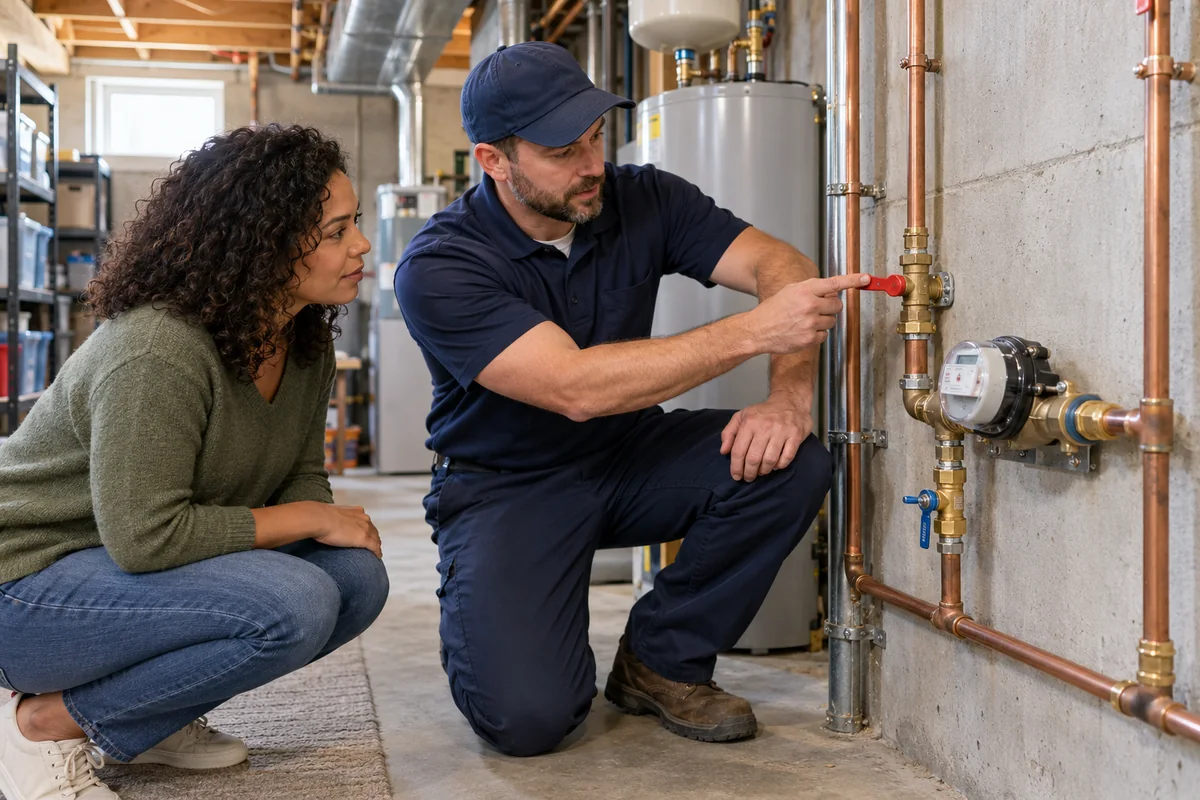
- Basement or crawlspace: Look near the foundation wall facing the street or water-meter location. The valve may be close to where a copper, plastic, or galvanized supply line enters.
- Utility or mechanical room: The main may be grouped with a pressure regulator, water meter, filtration equipment, or water heater, but do not assume every nearby valve controls the whole house.
- Garage: In slab-on-grade homes, a valve may be on an interior or exterior garage wall, sometimes behind an access panel.
- Exterior wall: In warm climates, the shutoff may be outside near a hose faucet, utility area, or point where the supply line enters the home.
- Underground meter box: Some properties have a customer valve near the meter. The utility-side valve may require a special tool and may be restricted to utility personnel.
- Well-system area: Homes with a private well may have valves near the pressure tank, but stopping flow can also require safe control of the well pump and electrical supply.
If you cannot find the valve, check inspection documents, building plans, labels left by a previous owner, or ask the property manager. A plumber can help identify and label the correct shutoff during a non-emergency visit.
How to recognize different valve types
Two designs are common in residential main-water service. A gate valve usually has a round wheel handle that turns several times. A ball valve normally has a straight lever that rotates one quarter-turn. When a ball valve is open, the handle is generally parallel with the pipe; when closed, it is generally perpendicular. Valve design and installation can vary, so do not rely on handle position alone if the piping has been altered or the handle is loose.
Older gate valves can become stiff, corroded, or internally damaged. A neglected valve may begin leaking at the stem when moved, or the gate may fail to close fully. Ball valves are often easier to operate, but they can also seize or develop leaks. Never use a wrench, pipe, hammer, or excessive body weight to force a valve. Turning a fragile valve into a broken valve can make the emergency worse.
How to prepare before an emergency
Once you have identified the likely main valve, make the area accessible and record its location for other responsible occupants. A simple tag can distinguish it from irrigation, water-heater, boiler, filtration, or individual fixture valves. Keep stored items from blocking the approach, and confirm that the path can be reached without climbing over equipment.
Do not conduct an unplanned shutoff test if the valve is heavily corroded, leaking, partly buried, painted in place, or difficult to move. Ask a plumber to assess it. When a sound valve is tested under appropriate conditions, plan for appliances and equipment that depend on water, follow manufacturer instructions, and check the valve and nearby joints for leakage after operation. In a rental, condominium, commercial property, or multi-unit building, obtain the required permission first.
What to do during an active supply-water leak
- Protect people first. Keep everyone away from wet electrical equipment, unstable ceilings, contaminated water, and slippery areas.
- Identify whether the water is supply water or wastewater. Clear water spraying or flowing continuously often suggests a supply problem. Water rising from a drain or toilet when other fixtures run suggests a drainage problem.
- Close the smallest safe valve that controls the leak. A working toilet, sink, or appliance valve may isolate the problem without shutting down the entire property.
- Use the main shutoff when necessary and safe. Operate it gently in the normal closing direction. Stop if the handle, stem, or surrounding pipe begins twisting, cracking, or leaking.
- Reduce additional damage. Move dry belongings away from spreading water only when the area is safe. Use containers or towels for minor residual dripping, not as a substitute for controlling active flow.
- Call for plumbing help. Explain what failed, whether the valve closed, which rooms are affected, and whether water is near electricity or structural materials.
After the main is closed, water may continue draining from upper pipes, a water heater, toilet tanks, filtration equipment, or other stored sources. Do not dismantle connections to relieve pressure. A plumber can determine what must be isolated, drained, repaired, and tested before service is restored.
How to tell whether the water is actually off
After closing the correct main valve, flow from an ordinary cold-water faucet should diminish as pressure is released. A brief flow does not necessarily mean the valve failed because water remains in the piping. If strong flow continues without decreasing, the wrong valve may have been closed or the main valve may not seal completely.
A partially closing valve may reduce the leak without stopping it. Tell the plumber exactly what happened rather than repeatedly forcing the handle. Also mention whether the property has a pressure booster, well system, storage tank, recirculation equipment, fire-sprinkler system, or shared supply. Those systems can change how water behaves and should not be operated casually.
Fixture shutoffs versus the main shutoff
Individual shutoffs are commonly found below sinks, behind toilets, near washing machines, and at some appliances. They are useful when one fixture or connection is leaking. Closing a local valve can allow toilets, sinks, and other essential fixtures elsewhere to remain usable until repair. However, a local valve that is corroded, leaking, missing a handle, or difficult to turn should not be forced.
The main shutoff is more appropriate when the leak is upstream of fixture valves, hidden within the building, affecting several branches, or too severe to isolate locally. If closing a fixture valve does not change the leak, stop experimenting and reassess. Water can travel along framing and appear far from its actual source, so the nearest visible drip is not always the failed connection.
What information helps when calling a plumber?
A concise description can help the provider understand urgency and prepare for the assessment. Give the service address and property type, then explain where water first appeared, whether it is still flowing, and which valve you closed. Mention changes in pressure, unusual sounds, recent freezing weather, appliance operation, renovation work, or prior leaks in the same area.
Photographs can document visible conditions if they can be taken without entering an unsafe area. Do not remove wall materials, open electrical equipment, or disassemble a water heater to get a better picture. Also identify access restrictions, pets, tenants, building-management contacts, and any person authorized to approve work.
Why a closed valve is only the first step
Stopping the water limits ongoing damage, but it does not identify why the failure occurred or confirm that the plumbing is safe to repressurize. A connection may have loosened, a pipe may have frozen or corroded, an appliance hose may have failed, or excessive pressure may have contributed. Wet building materials may also need appropriate drying and evaluation separate from the plumbing repair.
The plumber may inspect the visible failure, nearby pipe condition, valve function, pressure, and the route needed for access. Repair options depend on the pipe material, damage extent, location, code requirements, and whether the failure is isolated or part of a recurring pattern. Ask what will be repaired, what testing will follow, and whether any temporary work needs a later permanent correction.
Restoring water after a repair
Water should be restored in a controlled manner after authorized work is complete. Opening a valve too quickly can create abrupt pressure changes and may expose another weak connection. The person performing the repair should determine how the system will be refilled, which fixtures need air cleared, and what areas must be observed for leaks.
Some appliances and treatment systems have specific restart procedures. Water heaters should not be energized or fired when they are not properly filled, and well or booster systems may require additional steps. Follow the provider’s and manufacturer’s instructions rather than assuming every system can simply be switched back on.
Create a simple household shutoff plan
A useful plan does not need to be complicated. Record the main valve location, note whether it is a lever or wheel, keep the path clear, and make sure responsible adults know whom to call. Add the locations of important fixture valves and the electrical panel, but emphasize that nobody should enter water to reach electrical controls.
Review the plan after remodeling, buying a new appliance, changing a water-treatment system, or taking responsibility for a different property. Landlords and property managers should also establish who may operate shared valves and how tenants report active leaks. A few minutes of preparation can prevent confusion when water is already spreading.
When to request professional help
Arrange an assessment if the main shutoff cannot be located, will not move with gentle hand pressure, leaks when touched, or does not stop the flow. Request prompt help for a burst pipe, uncontrolled supply leak, water entering walls or ceilings, or moisture near electrical equipment. For sewage entering the building, stop using drains and follow wastewater-safety precautions instead of assuming the water main will solve the problem.
Learn more about leak detection and hidden-water symptoms, damaged-pipe repair decisions, and emergency plumbing safety steps. You can also review represented service locations before calling to confirm current provider availability for the property.